
Marvin NC Red Clay Soil: Why It Matters for Concrete
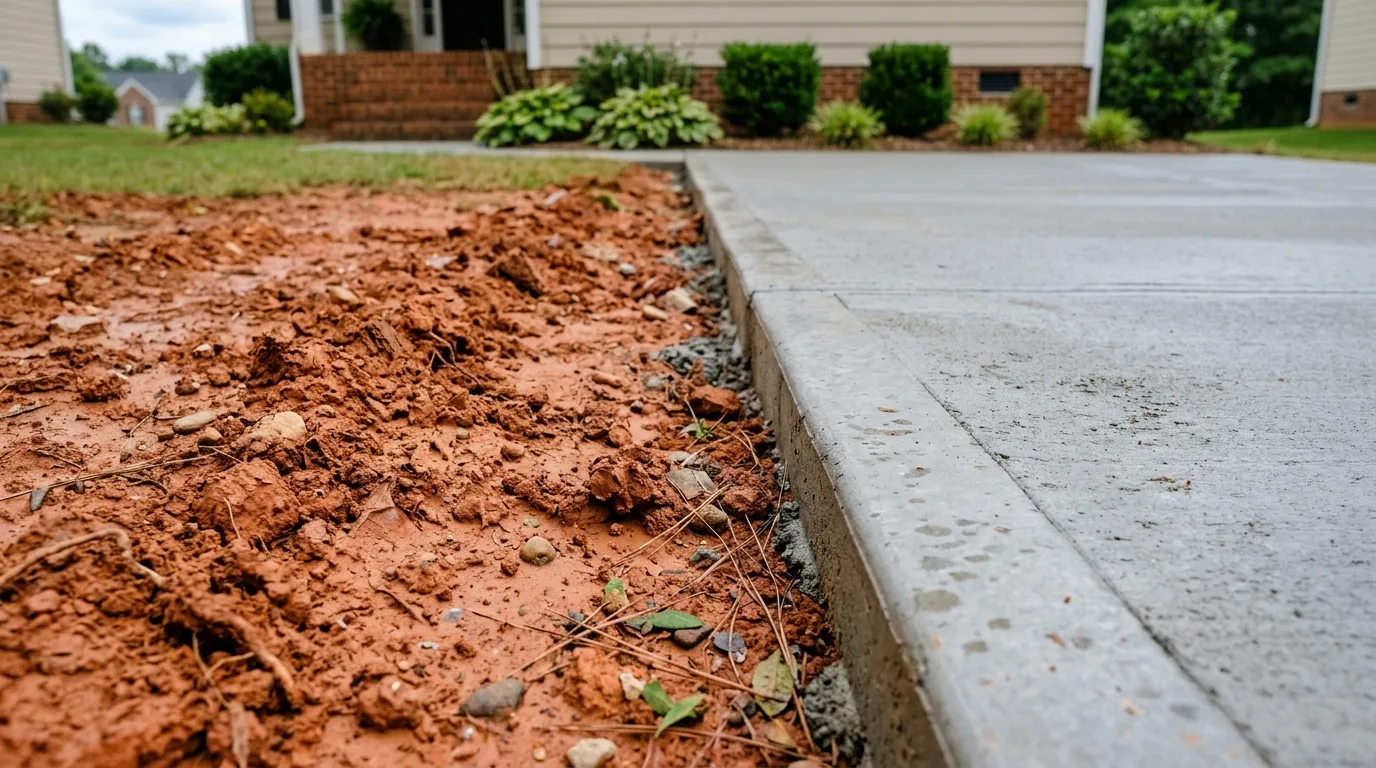
Most homeowners who call about cracked driveways or heaving patios in Marvin are surprised to learn that the real problem started beneath the concrete, not in it. Union County’s Piedmont red clay soil is one of the most challenging subgrade conditions for concrete in the southeastern United States — and understanding why it behaves the way it does explains most of the concrete damage patterns homeowners see in this region. In this post, we cover what makes Union County’s clay distinctive, how it interacts with concrete, and what proper preparation looks like.
Concrete Problems on Clay Soil in Marvin?
Free assessment — we diagnose whether clay soil movement caused your concrete damage.
Why Marvin’s Red Clay Behaves Differently Than Coastal NC Soil
Marvin sits in the Piedmont physiographic province of North Carolina — the region of rolling hills and red-orange soils that stretches from the Blue Ridge foothills to the coastal plain. The dominant soil type in Union County is kaolinite-rich red clay with montmorillonite content, a mineral combination that gives Piedmont clay its distinctive expansive behavior.
Unlike the sandy soils of coastal North Carolina — which drain quickly and provide relatively stable bearing capacity — Union County’s clay is very slowly permeable. Water that falls on clay soil in Marvin does not move through it quickly. The clay absorbs water and holds it, expanding volumetrically as it does so. This expansion is not subtle: saturated Piedmont clay can generate uplift pressures of up to 5,500 PSF — well above the bearing capacity needed to crack or heave a concrete slab. During dry periods, the reverse happens: the clay contracts, shrinks away from the underside of slabs, and creates the voids that cause concrete to rock and eventually fracture.
How Clay Soil Damages Concrete in Union County
The shrink-swell cycle is annual and relentless. Marvin receives 44.8 inches of rain per year — enough to keep Union County’s clay in a frequently saturated state through spring and fall. The driest month is May (2.9 inches), and the wettest is August (4.7 inches), with significant rain distributed across all months. This means the clay beneath any concrete slab is undergoing constant moisture fluctuation, and with it, constant dimensional change.
Concrete that sits directly on this clay without a drainage layer absorbs the movement. In early stages, hairline cracks appear — often dismissed as normal concrete shrinkage. Over time, these cracks widen as freeze-thaw cycles work water into the openings. North Carolina’s 57.7 below-freezing days annually freeze that water, expanding it and forcing cracks wider. Within 5–10 years, slabs that were poured on unprep’d clay typically show:
- Transverse cracking: cracks running across the full slab width
- Corner cracking: where clay uplift stress concentrates
- Settlement: sections dropping 1–3 inches as clay voids form below
- Heaving: sections lifting as saturated clay pushes upward
Practical Uses: Where Clay Soil Issues Show Up
- Driveways in Weddington Chase and Marvin Creek: Clay content is high in these Marvin subdivisions. Driveways without gravel subbase typically crack within 3–7 years of installation.
- Patio slabs adjacent to downspout discharge: Roof runoff concentrated near a patio edge saturates the clay below one side, causing differential heaving and a tilted surface.
- Shed and workshop foundation pads: Small slabs with less inherent weight are more susceptible to uplift pressure from saturated clay.
- Walkway sections near tree root zones: Tree roots compete with clay for moisture, creating localized drying voids that cause walkway sections to settle or tilt.
- Garage floor slabs on new construction fill: Sites where existing topography required fill material may have inconsistent compaction, creating differential settlement in garage slabs.
- Foundation walls in expansive clay zones: Basement and crawlspace walls can show horizontal cracking from lateral clay pressure when soil moisture is high.
The Correct Subgrade Preparation for Marvin’s Clay
Proper concrete installation on Union County’s clay requires a specific sequence:
- Excavation: Remove the topsoil and expansive clay layer to a depth that reaches stable, less permeable material — typically 6–8 inches below finish grade for residential slabs.
- Compaction: Compact the exposed subgrade material to eliminate loose areas and establish uniform bearing capacity.
- Gravel base: Install 4–6 inches of compacted crushed stone (NCDOT #57 or similar). This layer serves two purposes: it provides uniform bearing support for the slab, and its open-graded particle structure allows water to drain away from the underside of the slab rather than accumulating.
- Drainage considerations: Ensure the project site drains water away from the slab perimeter. If the native site grade does not support this, surface swales or French drains may need to be incorporated.
Planning Concrete Work in Marvin NC?
We explain the exact subgrade process for your site's clay conditions — free estimate.
Cost Implications of Clay Soil Prep in Union County
The correct subgrade preparation for Marvin’s clay adds real cost to any concrete project — typically $0.75–$1.50 per square foot for a standard residential driveway or patio. On a 400 sq ft double-car driveway, this represents $300–$600 in additional preparation cost compared to a simpler flat-ground pour. This cost difference is why some contractors quote lower prices for Marvin concrete work than others — they are skipping the preparation that the clay soil demands.
Homeowners who choose the lower quote without proper prep frequently contact concrete contractors again within three to five years, facing repair or replacement costs that far exceed what the subgrade preparation would have cost upfront. The concrete itself is not the problem in these cases — the missing drainage layer and unstable clay subgrade are.
Frequently Asked Questions
How do I know if clay soil caused my concrete damage in Marvin?
The most telling signs of clay-related concrete damage are differential movement — one section higher or lower than adjacent sections — and cracking patterns that follow the slab’s longer dimension rather than random surface checks. If sections of your driveway or patio rock slightly when walked on, voids have likely formed below due to clay contraction. If corners have lifted, saturated clay expansion is the likely cause. A concrete contractor familiar with Union County soil conditions can assess the pattern and confirm the root cause.
Can I fix concrete that was damaged by clay soil without addressing the clay?
Surface repairs alone — crack filling, spall repair, or resurfacing overlays — will not produce lasting results if the clay soil movement that caused the original damage continues. A crack fill over a slab with active clay movement beneath it re-opens when the clay shifts again, usually within one or two winter seasons. Lasting repair requires either addressing the drainage situation that keeps the clay saturated, or full slab replacement with proper subgrade preparation. We are honest about this assessment — we won’t recommend a repair approach that will require you to call us again in two years. Read our full repair guide for more context: concrete repair for Marvin homeowners.
Does clay soil affect concrete foundations differently than driveways?
Foundations experience the same expansive clay pressure as driveways and patios, but the consequences can be more serious because foundation damage affects structural integrity and habitability. Foundation walls in Union County frequently show horizontal cracking from lateral clay pressure during wet seasons. Properly designed foundations use deeper footings that reach below the active clay layer and may incorporate drainage systems to reduce moisture accumulation against foundation walls. Read our guide on concrete foundation repair in Union County for more detailed information.
Get Expert Concrete Advice for Union County Clay
Call Marvin Concrete Pros at (888) 376-0955 — we build concrete that works with this soil, not against it.
Related: