
Exposed Aggregate vs Stamped Concrete: Which for Charlotte Area Homes?
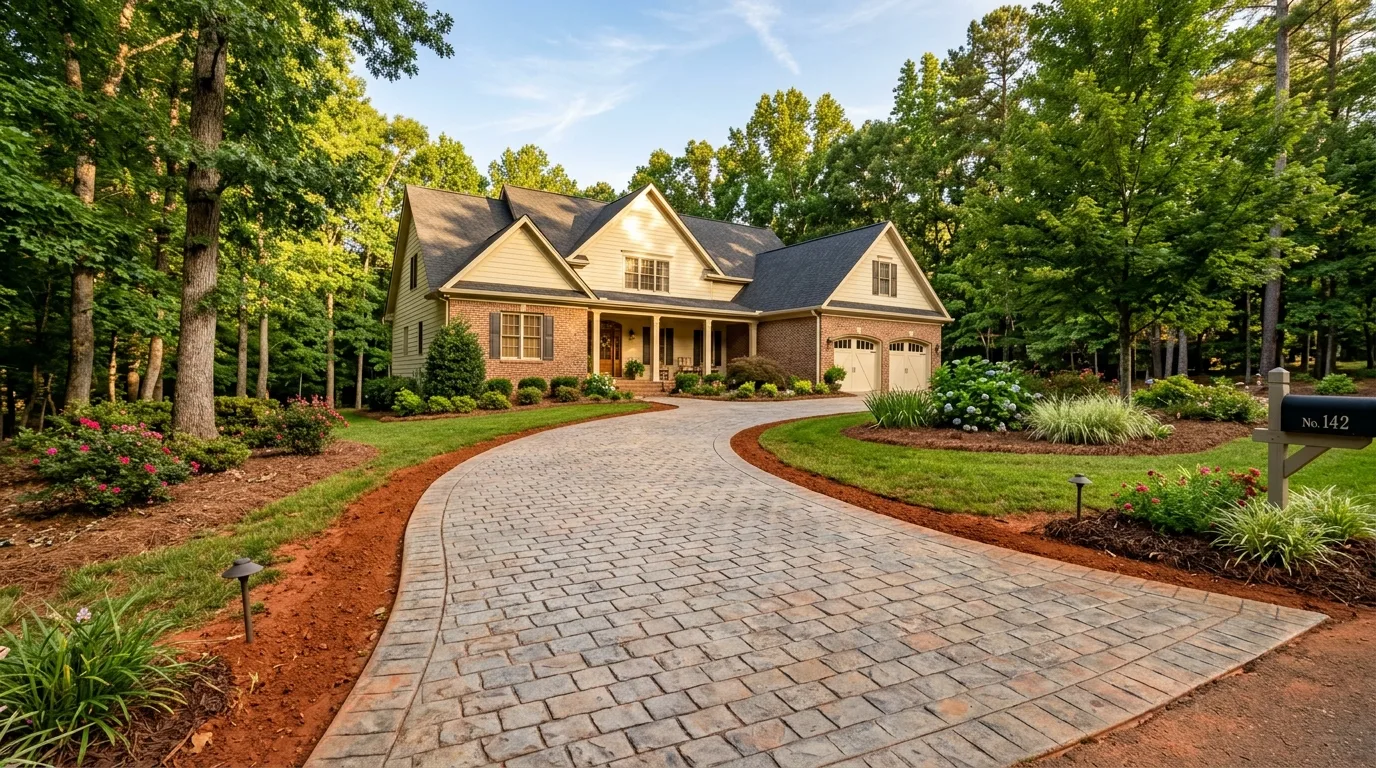
Marvin and Weddington homeowners who want to go beyond plain gray concrete for their driveway, patio, or walkway typically face a choice between two decorative options: exposed aggregate and stamped concrete. Both are significantly more appealing than standard broom finish, but they differ in appearance, cost, durability, maintenance, and suitability for different applications in the Charlotte metro climate. This post breaks down the real comparison so you can choose the right finish for your specific project.
Decorative Concrete Estimate for Your Marvin Home
We help you choose the right finish for your project — free estimate and design consultation.
What Exposed Aggregate Concrete Is
Exposed aggregate concrete is produced by seeding decorative stones — rounded river pebbles, granite chips, quartz, or other aggregate — into the surface of the concrete while it is still plastic, then washing away the cement paste from the top layer to reveal the aggregate faces. The result is a natural, textured surface where the stone aggregate is visible and tactile.
The process can be done with the concrete’s natural aggregate (using a surface retarder to prevent the top paste from setting, then washing), or by seeding decorative aggregate for specific colors and textures. Natural North Carolina river pebble aggregate in warm browns and tans is common in Marvin — it complements the region’s warm-toned architectural palette and resists clay staining better than lighter aggregates.
What Stamped Concrete Is
Stamped concrete is poured as a standard slab and then impressed with rubber stamp mats while the concrete is still in its plastic state, creating patterns that mimic natural stone, brick, slate, cobblestone, or wood grain. Color is introduced through integral color mixed throughout the concrete and/or a dry-shake release agent dusted on the surface before stamping that adds color variation and prevents the stamps from bonding.
The result is a surface with defined pattern lines and color variation that can closely resemble natural materials — a capability that exposed aggregate does not offer. Stamped concrete is the right choice when pattern and design are the primary goals; exposed aggregate is the right choice when natural texture and a more understated appearance are preferred.
Cost Comparison for Marvin NC Projects
Exposed aggregate:
- Adds $1.50–$3.00 per square foot over plain broom-finish concrete
- A 400 sq ft driveway with exposed aggregate runs approximately $4,000–$5,500 installed
- Lower decorative labor cost than stamped concrete; seeded decorative aggregate adds material cost
Stamped concrete:
- Adds $3.00–$6.00 per square foot over plain concrete
- A 400 sq ft patio in single-color stamped concrete runs approximately $5,500–$8,000 installed
- More complex patterns and dual-color designs push toward the upper end
- Resealing cost (every 2–3 years) is similar for both finishes
The cost difference reflects the skill and time required for stamping — crews must pattern the entire surface in a tight window while the concrete is workable. Exposed aggregate’s surface treatment is less time-sensitive.
Durability in North Carolina’s Climate
Both finishes require proper subgrade preparation for Union County’s clay soil — the structural foundation is identical regardless of surface treatment. The durability differences are in how each finish ages in Marvin’s climate.
Exposed aggregate durability: The rough aggregate surface provides inherently excellent slip resistance — one of its primary practical advantages. The surface does not require color maintenance the way stamped concrete does; the aggregate’s natural color does not fade. However, the open texture of exposed aggregate can accumulate clay staining from rain splash in Marvin’s red-clay environment, and deep cleaning is occasionally needed to maintain appearance. Sealing exposed aggregate fills some of the surface voids, reducing maintenance, and protects against freeze-thaw damage to the cement matrix between aggregate particles.
Stamped concrete durability: The primary durability concern with stamped concrete in North Carolina’s freeze-thaw climate is the integral color and sealer system. Unsealed or under-sealed stamped concrete fades significantly in Marvin’s 217 sunny days per year and can suffer surface scaling from the 57.7 freeze-thaw days annually. With consistent resealing (every 2–3 years), stamped concrete maintains its appearance and structural integrity reliably over 25+ years.
Practical Uses: Which Finish for Which Application
- Front driveway: Exposed aggregate — natural appearance blends with most home styles; lower decorative cost; inherent slip resistance for vehicle turning lanes; ages gracefully without color fading concerns.
- Backyard patio: Stamped concrete — pattern and color design options complement specific architectural styles; creates a more refined, designed space for entertaining.
- Pool surround: Exposed aggregate — inherently non-slip surface is the primary safety requirement; exposed stone stays cooler underfoot than smooth surfaces in Marvin’s summer sun.
- Front walkway: Either works; exposed aggregate for understated natural look, stamped cobblestone or brick for homes with formal exterior architecture.
- Driveway border or apron: Stamped concrete — the decorative pattern contrast adds visual interest to a plain aggregate or asphalt driveway field.
- Side yard service path: Exposed aggregate — functional, durable, lower decorative cost appropriate for non-primary-view areas.
Exposed Aggregate or Stamped? We Help You Decide
Free consultation and estimate for decorative concrete in Marvin and Union County.
Maintenance Comparison for Union County Homeowners
Both decorative finishes require resealing every 2–3 years in North Carolina’s climate. The maintenance processes differ slightly:
Exposed aggregate maintenance: Clean annually to remove clay staining (Marvin’s red clay can stain lighter aggregate significantly). Reseal with penetrating sealer to reduce staining absorption and protect the cement matrix between aggregate from freeze-thaw damage. No color maintenance required — the aggregate’s natural color is permanent.
Stamped concrete maintenance: Clean to remove surface dirt and clay; inspect color for fading. Reseal with UV-stabilized sealer every 2–3 years to maintain color vibrancy and surface protection. Film-forming acrylic sealers (which produce the “wet look”) may peel as they age and need stripping before reapplication — penetrating sealers avoid this issue. Color touch-up between resealing cycles is not typically needed with consistent sealing.
Frequently Asked Questions
Which is easier to repair — exposed aggregate or stamped concrete?
Exposed aggregate is easier to repair because color matching is not required — the aggregate’s natural appearance is consistent across different batches. Patching stamped concrete requires matching the original color and pattern, which is difficult to achieve perfectly on an aged surface where the existing color has faded from years of UV exposure. For this reason, exposed aggregate is often recommended for driveways where section damage from vehicle loads or clay movement is more likely.
Can exposed aggregate be done on an existing concrete driveway?
Exposed aggregate requires the retarding and washing process to be applied to fresh concrete — it cannot be applied to existing hardened concrete as a surface treatment. An existing concrete driveway can receive a micro-topping overlay that includes exposed aggregate, but this is a different product (a bonded overlay rather than integral exposed aggregate) with different performance characteristics. True exposed aggregate requires a fresh pour. See our driveway replacement options: concrete driveway installation in Marvin NC.
How does each finish handle ice in Marvin’s winters?
Both finishes handle Marvin’s ice events adequately when properly sealed. Exposed aggregate’s inherent texture provides more natural traction on wet or lightly iced surfaces than smooth finishes. Both are susceptible to de-icer damage — avoid sodium chloride and calcium chloride on either decorative finish and use sand for traction instead. See our winter maintenance guide: concrete maintenance through North Carolina winters.
Choose the Right Concrete Finish for Your Marvin Project
Marvin Concrete Pros — free estimate, design guidance, and proper clay soil prep on every project.
Related: